Wireless sensors read every fridge, freezer and cool room on site. A temperature that goes out of range reaches your phone in minutes. Every reading is kept, and the month comes out as a report you can hand straight to an auditor.
Screenshots below are of the demo site. It is the same software and complete end to end system your site would run.
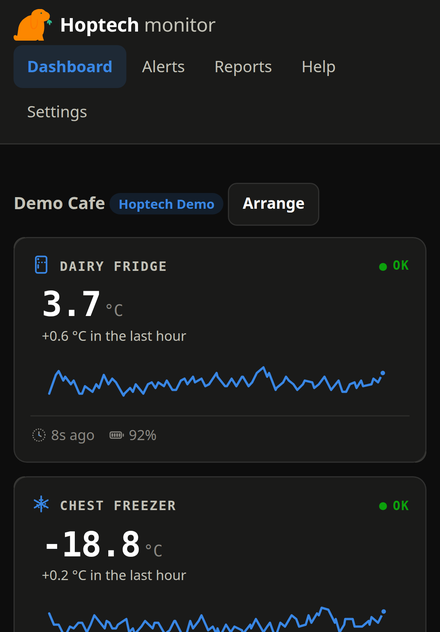
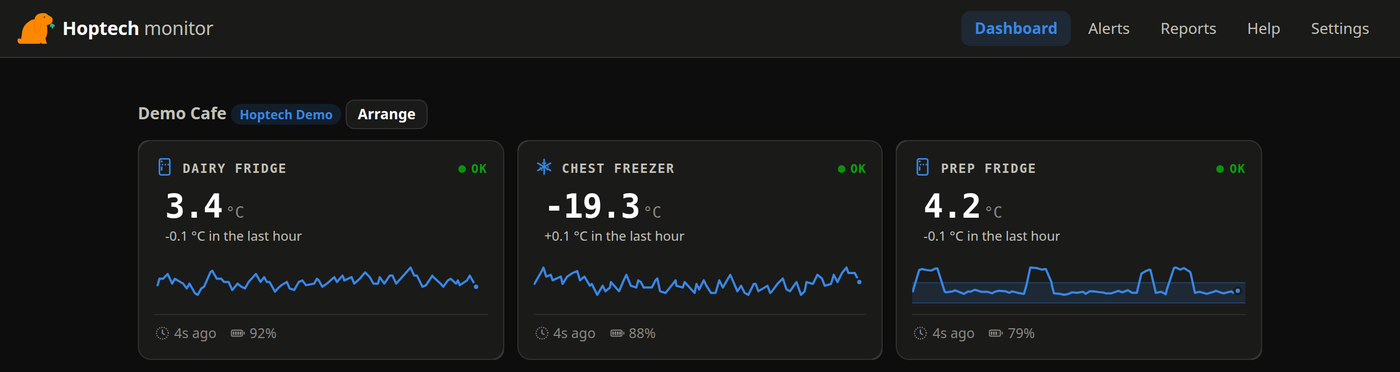
Current temperature, which way it has moved in the last hour, the last few hours as a trace, and how much battery is left. Green means inside the range you set.

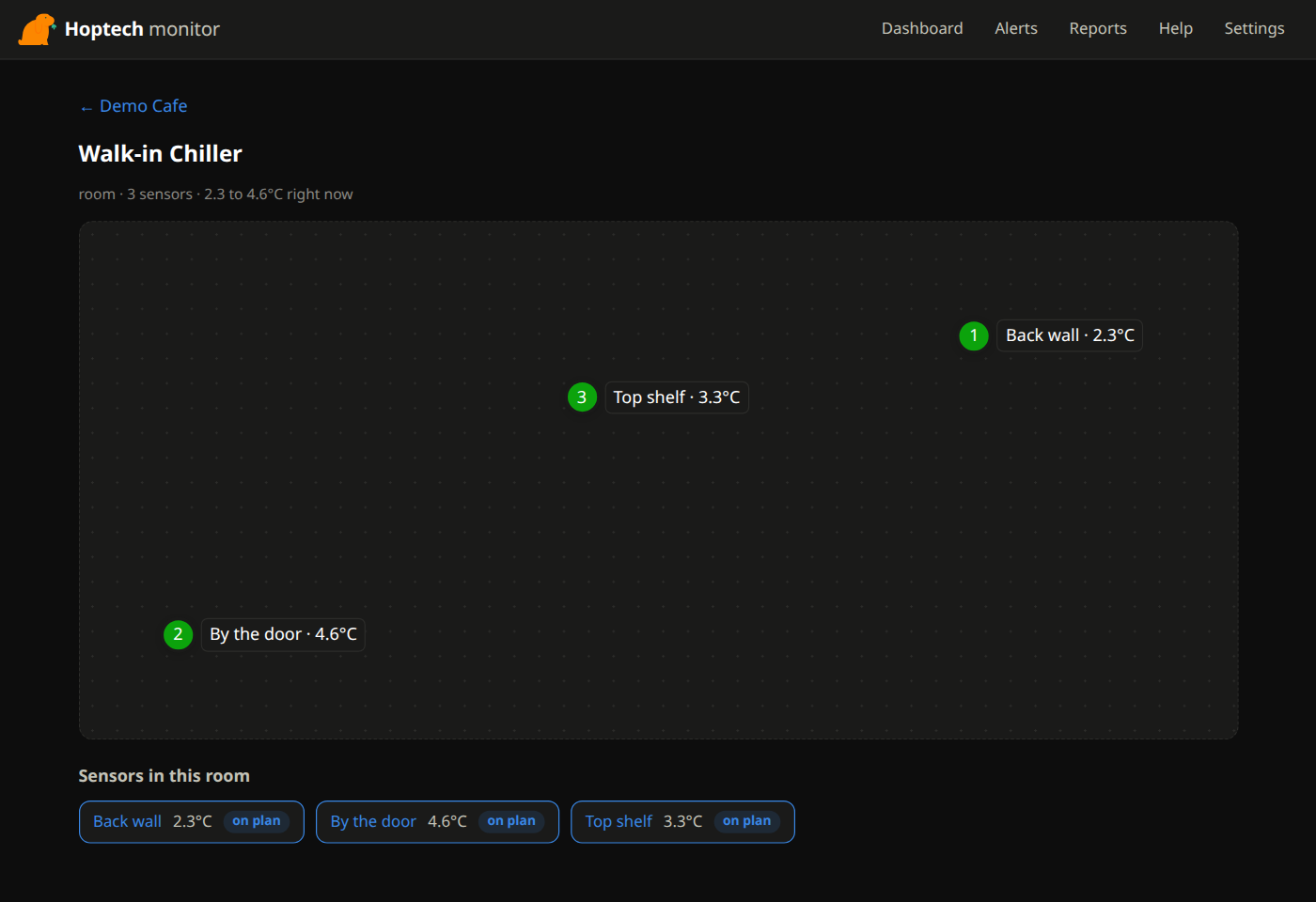
A walk-in chiller is not one temperature: the air by the door runs warmer than the air at the back. Put several sensors in a room and the dashboard shows it as one card, with the range across them, how far apart they are, and the worst state among them.

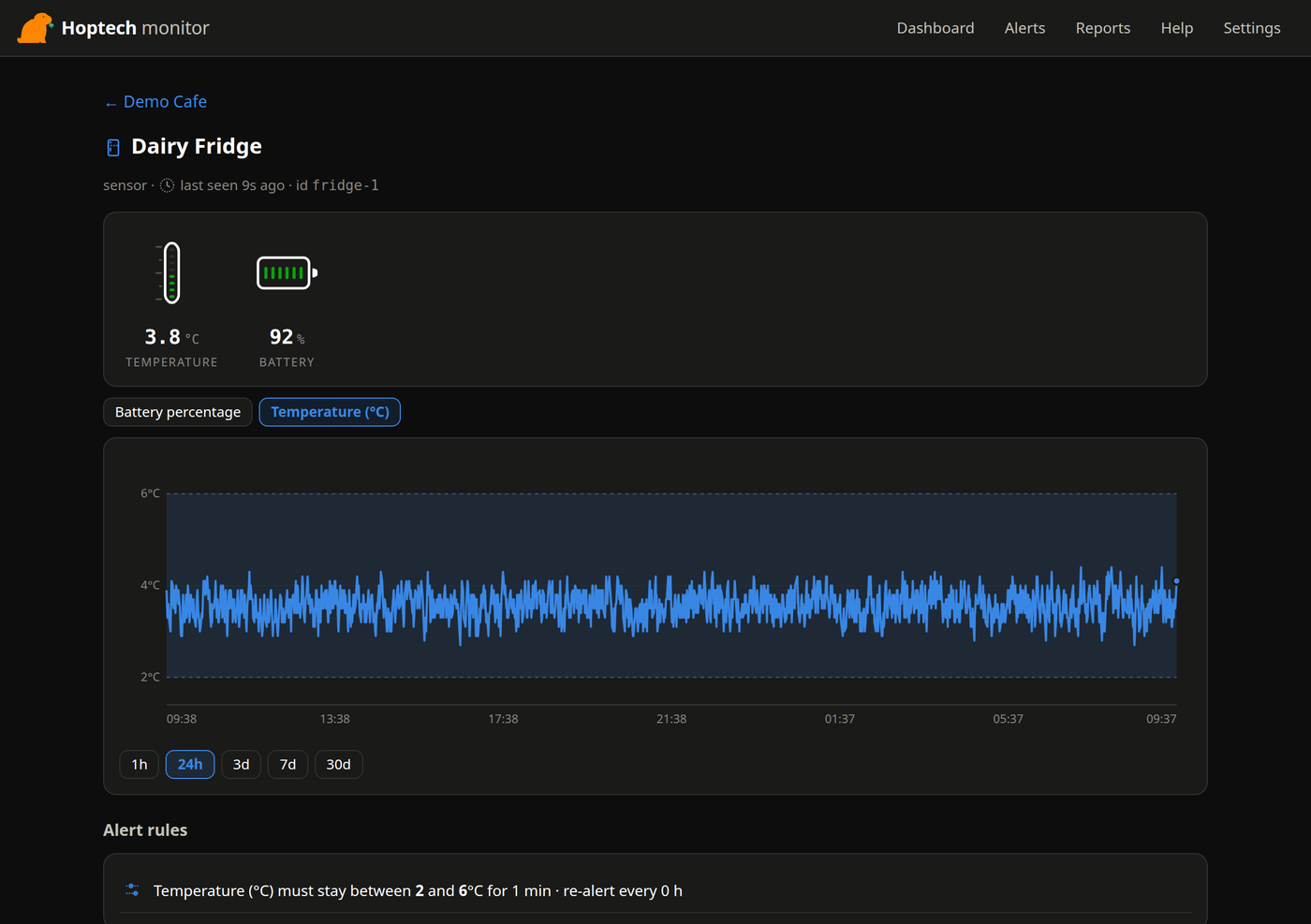
Open a fridge's page and you get its history at 1 hour, 24 hours, 3 days, a week or a month, with the allowed range shaded behind the line. Underneath it, the rule that governs it: must stay between 2 and 6°C for 1 min. No thresholds buried in a settings page.

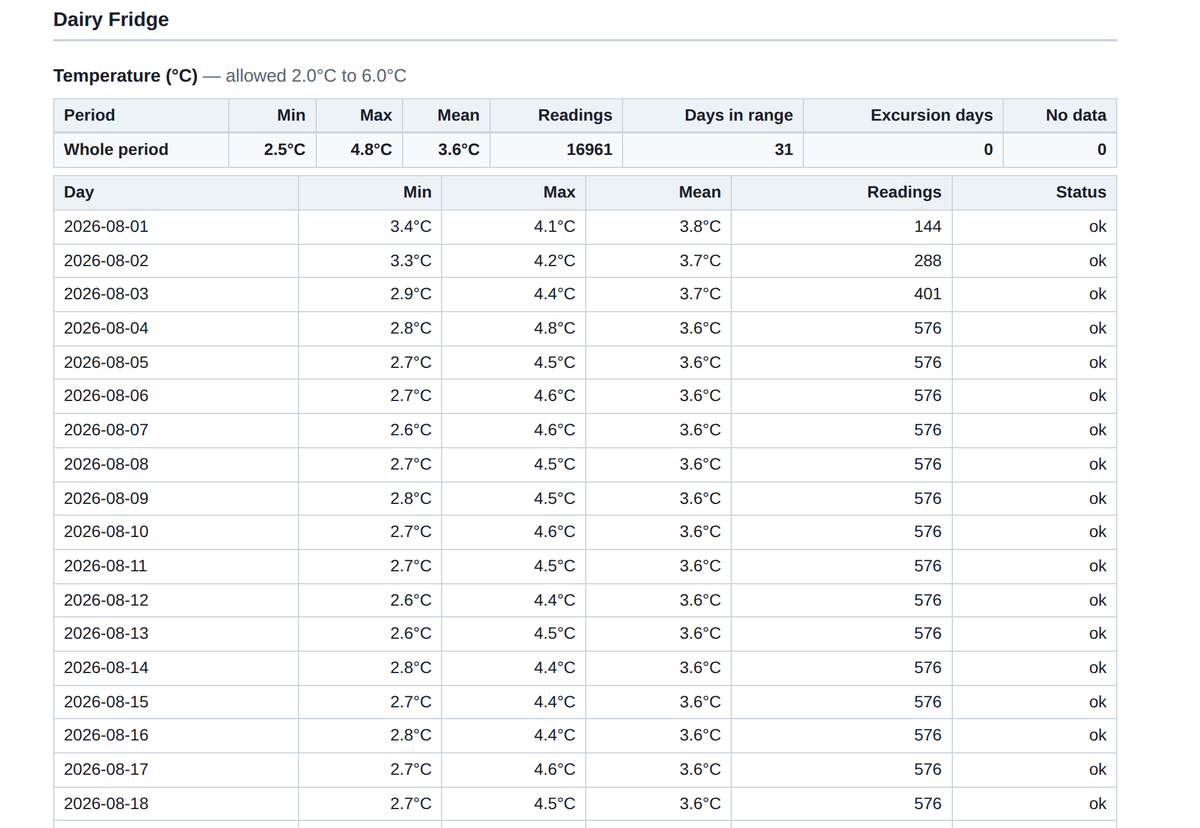
Minimum, maximum and mean per fridge per day, the number of readings behind each figure, and any day that went out of range marked. Download it as CSV or hand over the page.

Three parts, about twenty minutes to set up, and nothing for staff to do afterwards. The sensors are wireless and the gateway uses the WiFi you already have.
A sealed sensor sits on a shelf and broadcasts its temperature every few seconds for years on one coin cell. No wiring and nothing to pair.
A palm-sized hub scans for sensors on site and forwards the readings. It keeps them locally through a power cut and back-fills the gap afterwards.
A PWA that simply runs on any phone, push and email alerts when something drifts out of range, and a temperature report per fridge every month, stored on the server for you to retrieve when needed.
Designed and assembled in New Zealand. The sensors have no buttons and no screen. The gateway updates its own firmware, so neither needs a site visit once fitted.
A sealed puck that lives on a fridge shelf. It broadcasts a reading every few seconds over Bluetooth Low Energy and does nothing else, which is why one coin cell lasts years rather than months.
| Measures | Temperature, ±0.3 °C |
|---|---|
| Range | −30 to +60 °C |
| Reporting | Every few seconds, continuously |
| Battery | 2+ years, one CR2477 coin cell |
| Radio | Bluetooth LE beacon |
| Fitting | Sits on a shelf or sticks to a wall |
One per site. It listens to every sensor in range and forwards readings over your WiFi. The interesting part is what it does when things go wrong: it keeps a local backlog through an outage and back-fills it afterwards, so the record has no hole in it.
| Sensors | Up to 32 per gateway |
|---|---|
| Backhaul | WiFi 2.4 GHz, 4G on request |
| Outage cover | Local backlog, back-filled on reconnect |
| Updates | Over the air, no site visit |
| Power | USB-C, about 1 W |
| Setup | From a phone, about 5 minutes |
The hardware is the same in each case. What changes is the range, the hold time, and who reads the report at the end of the month.
The hardware is yours outright. The monthly fee covers the monitoring, the alerts and the reports, and stops when you say so. Prices below are in New Zealand dollars and exclude GST.
NZD, excluding GST. A starting point for a single site; your quote confirms it.
You buy the hardware once, from NZ$349 for a gateway and two sensors, then pay NZ$25 per site per month for the monitoring, alerts and records. Extra sensors are NZ$89 each plus NZ$5 a month. Prices exclude GST.
Yes. The demo is a live site with fridges that drift, alert and recover on their own, signed in as a customer would be. You can stage an excursion yourself and watch the alert arrive on your phone.
As fast as you want, within reason. Each rule has a hold time: the temperature must stay out of range for that long before it alerts. Set it to a minute and a propped door will tell you; set it to twenty and only a real fault will. The default for a fridge is fifteen minutes, which ignores a normal service period and catches a compressor.
The gateway keeps readings locally and back-fills them when power or internet returns, so the record has no hole in it. If the gateway itself stops reporting, that raises an alert of its own.
No. The sensors are wireless and run for years on a coin cell. The gateway plugs into a power point and joins the WiFi you already have. A typical site takes about 20 minutes to set up.
Two years of full-resolution readings per sensor, and the monthly reports stay available for as long as you are a customer. You can download any month as CSV at any time.
Yes. Everyone at the business gets their own login, and each person chooses whether they want push notifications, email, or nothing. A manager can be given one branch or all of them.
Get started
The demo is a live site, signed in and already running. If it does what you need, send a photo of your fridges and we will quote the install by reply.