Nearly every food safety programme built on HACCP asks the same three things of chilled storage: keep it in range, record that you kept it in range, and show what you did when you did not. In New Zealand that is a Food Control Plan under the Food Act 2014. The shape of the obligation is much the same elsewhere.
The first is a refrigeration problem. The second and third are paperwork problems, and they are the ones that fail audits.
Why the diary is the weak point
A temperature diary records the moments somebody stood in front of a fridge with a pen. That is typically twice a day, on weekdays, during service. It is not a record of the fridge; it is a record of the staff rota.
Which matters, because the failures that cost you stock do not happen during service. A compressor gives up on a Saturday night. A door is left on the latch after a delivery. A defrost cycle sticks. A power cut at 2am comes back at 4am and everything looks normal by the time the kitchen opens. None of that appears in a diary, and all of it appears in a continuous record.
There is a second problem, which nobody enjoys discussing: a diary filled in from memory at the end of a shift is not evidence of anything, and an experienced verifier can tell. Fourteen consecutive days of "4°C" in the same pen is not a fridge, it is a habit.
What continuous monitoring changes
A sensor on the shelf reads every few seconds, whether or not anybody is there. That turns the three obligations into three answers you already have:
- In range. You find out when it is not, in minutes, from a phone.
- Recorded. Every reading is kept for two years, at full resolution.
- Responded to. The alert log shows when each excursion opened, how long it lasted and when it cleared, which is exactly the timeline a verifier asks you to describe.
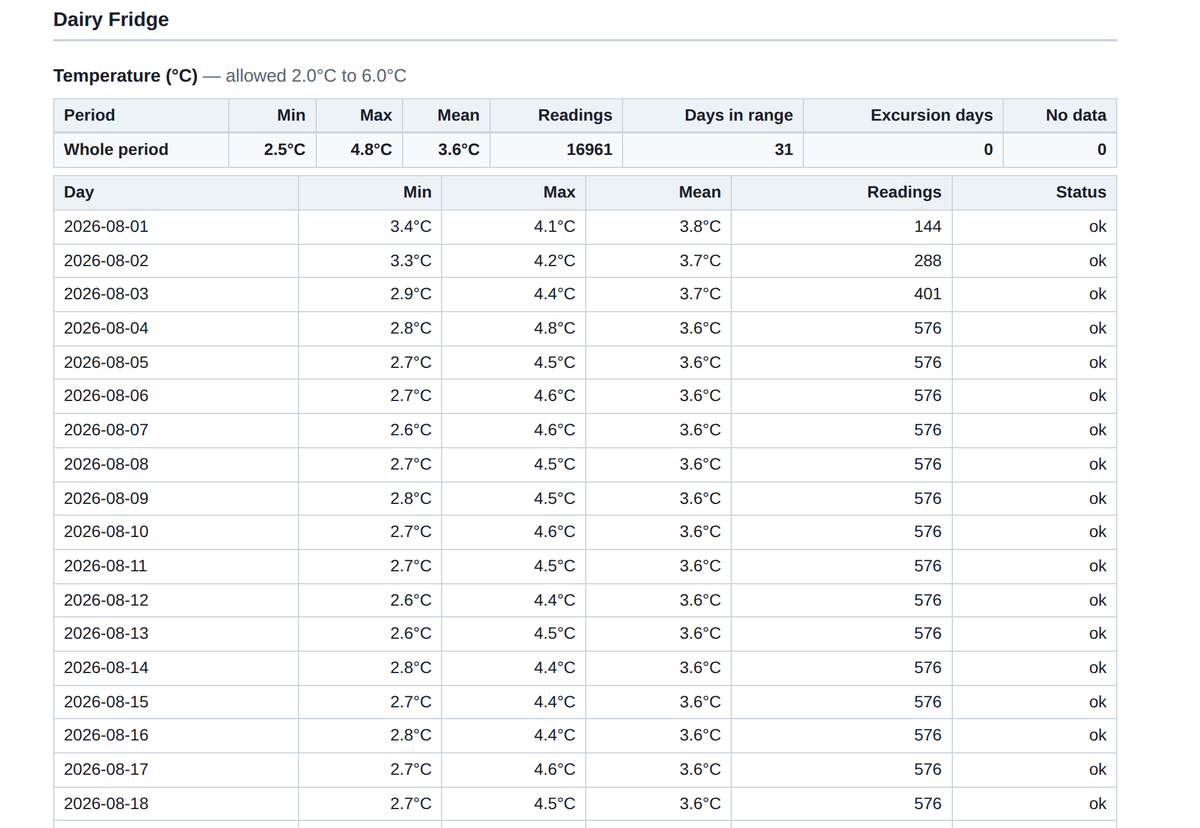
One fridge, one month. 16,961 readings behind 31 rows.
Setting a range that does not cry wolf
The most common reason people abandon a monitoring system is that it alerts constantly and everybody learns to ignore it. Two settings prevent that.
The allowed range
Set it wider than your target, not equal to it. If you run a dairy fridge at 3°C, an allowed range of 2 to 6°C gives the compressor room to cycle and a door room to open. The target is what you aim at; the range is what you want to hear about.
The hold time
This is the setting that makes the difference. A rule only fires once the temperature has been out of range continuously for a set period. Fifteen minutes ignores service, a delivery and a restock, and still catches a compressor that has stopped, because a failed fridge does not come back down on its own. A chest freezer can take longer, because it has hours of thermal mass. A display cabinet that is opened every ninety seconds needs longer again.
Every excursion is still recorded regardless of whether it alerted. The hold time controls who gets woken up, not what goes in the record.
Where to put the sensors
One per cabinet you need to be able to prove. Beyond that:
- Put it where the food is, this gives you the most accurate picture of the conditions the food experiences.
- A cool room usually wants two: the air by the door and the air at the back are not the same air, and on a hot day with a busy kitchen they can be several degrees apart.
- Chest freezers read best near the lid, which is the warmest point and therefore the one that matters.
What you hand over during an audit
A page per fridge per month: minimum, maximum and mean for each day, the number of readings behind each figure, and any day that went out of range marked. Underneath that, if it is asked for, the alert log with the duration of each excursion.
The reading count is worth more than people expect. "31 days, all in range" is a claim. "31 days, all in range, 16,961 readings" is a claim with its working shown.
Questions
What temperature should a commercial fridge be?
Most chilled storage in a food business is run at 2 to 4 degrees Celsius, with an alarm range a little wider than that so that normal door openings do not trip it. Frozen storage is usually held at minus 18 degrees or below. Your own food safety programme is what sets the number you have to meet, and Hoptech lets you set the range per fridge rather than one number for the whole site.
Does this replace my paper temperature diary?
It replaces the readings. A diary is a record of spot checks somebody remembered to take; Hoptech records every few seconds, including overnight and across a long weekend, which is when fridges actually fail. What it does not replace is your documented response when something goes out of range, and that is the part a verifier will ask about.
What happens if a fridge goes out of range during a delivery?
Nothing, if you have set the hold time sensibly. A rule only alerts once the temperature has stayed out of range for a set period, so a door held open while stock goes in is ignored and a compressor that has stopped is not. The excursion still appears in the record with its duration, which is the honest outcome: it happened, it was brief, and here is how long it lasted.
How many sensors do I need?
One per cabinet you have to be able to prove. A typical cafe runs three or four: a dairy fridge, a prep fridge, an under-counter and a chest freezer. Cool rooms usually want two, because the air near the door is not the air at the back.
What does a verifier actually want to see?
That the temperatures were monitored, that the records exist for the period being verified, and that somebody did something when a reading was wrong. The monthly report answers the first two on one page per fridge. The alert log answers the third, because it shows when each excursion opened, how long it ran and when it cleared.
Can I still get a record if the internet goes down?
Yes. The gateway keeps readings locally and sends them when the connection returns, so the gap is back-filled rather than lost. A gateway that stays silent raises its own alert, so a monitoring system that has quietly stopped does not go unnoticed.
Open the demo and set a rule yourself
It is a live site with fridges that drift and recover on their own. You can stage an excursion and watch the alert arrive, without giving anyone an email address.