A cold chain failure is not usually discovered by the thermometer. It is discovered weeks later, when somebody works out that a fridge was out of range on a date nobody was recording, and the question becomes how much stock has to be written off and how many patients need recalling.
The cost of that question is almost entirely a function of how good your records are. With a daily chart you are guessing. With a continuous record you know the exact minute it started, the exact peak, and the exact minute it came back.
What a cold chain policy actually asks for
The details vary by country and by programme, but the common requirements are consistent:
- A dedicated vaccine fridge, not a domestic one shared with lunches.
- Temperatures inside the accepted range, typically +2°C to +8°C, with +5°C as the target.
- A minimum and maximum recorded at least once every working day.
- Continuous monitoring, with an alarm, so an out-of-hours excursion is not invisible.
- A written procedure for what happens when an excursion is found, and evidence it was followed.
- Records retained and produced at cold chain review.
Follow your own immunisation programme for the numbers. What Hoptech does is make the last three cheap.
The excursion is the whole product
When a vaccine fridge goes out of range, the correct response is not to throw the stock away. It is to quarantine it, label it as not for use, keep it at the right temperature, and get advice with the specifics in hand. Manufacturers publish stability data, and a great deal of vaccine stock that gets discarded did not need to be.
The specifics are the bottleneck. "It was warm this morning" gets you a precautionary write-off. "It reached 11.4°C, it was above 8°C for 3 hours 40 minutes between 01:50 and 05:30, and it has been at 4.6°C since" gets you an actual answer. That is the difference a continuous record makes, and it is usually worth more than the monitoring costs in a single event.
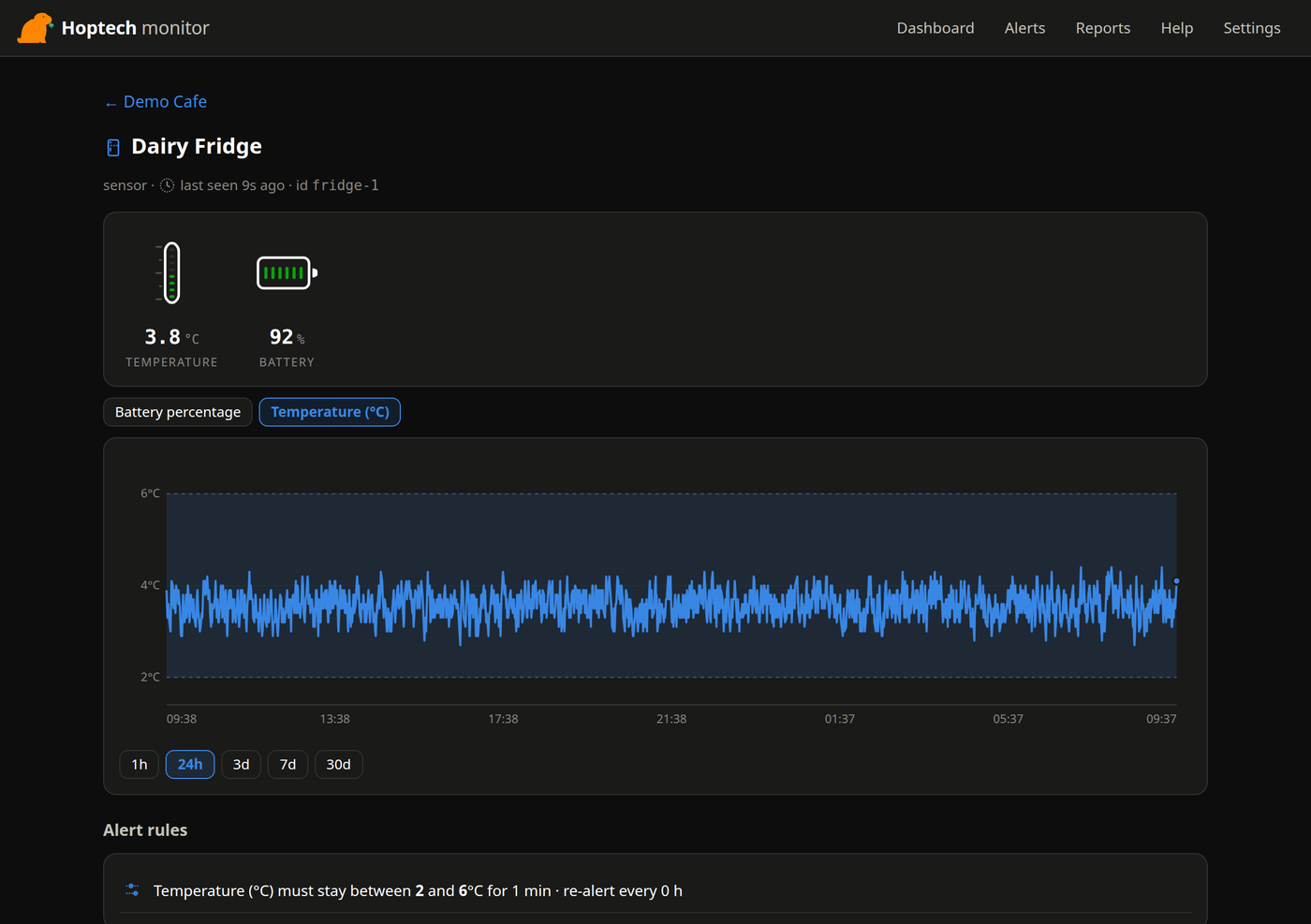
The allowed range is shaded behind the trace, so an excursion is visible at a glance and measurable.
Alarms that reach a person
An alarm on the fridge door is only useful if somebody is standing next to it. Hoptech alerts go to phones:
- Push notification to each person who has them on, with the app closed.
- Email as well, for the people who would rather have that.
- Re-alerts on a schedule until it clears, so a notification missed at 2am is sent again.
- Silence is its own alarm: a sensor or gateway that stops reporting raises an alert, so a monitoring system that has failed cannot sit there looking fine.
That last one matters more in a clinic than anywhere else. The failure mode of a cheap logger is not a wrong reading, it is no reading, discovered at the next download.
Dispensary and pharmacy stock
The same applies to refrigerated medicines in a pharmacy dispensary: insulin, some antibiotics, biologics and anything else the data sheet says to keep at 2 to 8 degrees. One sensor per fridge, the range set to the product requirement, and a record you can produce if a supplier or an auditor asks what happened over a specific weekend.
What you get at an audit
A page per fridge per month with the daily minimum, maximum and mean, the number of readings behind each row, and any day that left the range marked. The alert log alongside it shows each excursion with its start, duration and resolution. Both download as CSV.
Questions
What temperature should a vaccine fridge be?
The internationally accepted cold chain range for most vaccines is +2 to +8 degrees Celsius, with +5 degrees as the usual target so there is room either side. Your national immunisation programme and the product data sheets are what set the requirement; Hoptech lets you set the range and the alarm behaviour per fridge.
How often does a vaccine fridge have to be checked?
Most cold chain policies expect a minimum and maximum reading recorded at least once every working day, and continuous monitoring in between. A daily min/max written on a chart meets the letter of that. It does not tell you what happened at 3am on Sunday, which is why continuous logging with an alarm is the direction every cold chain standard has moved in.
What happens if a vaccine fridge goes out of range?
Do not discard the stock and do not assume it is fine. Standard practice is to quarantine the affected vaccines, label them as not for use, keep them at the correct temperature, and seek advice from your immunisation coordinator or the manufacturer with the excursion details: how far out of range, for how long, and when. Hoptech gives you exactly those three numbers rather than an estimate.
Does this replace a min/max thermometer?
It gives you the same numbers and keeps them. Many clinics keep a min/max thermometer in the fridge as a physical cross-check and a fallback, which is sensible; the two do not conflict. What continuous monitoring adds is the alarm, the overnight coverage and the record that does not depend on anyone transcribing it.
Will it alert someone overnight and at weekends?
Yes. Alerts go to each person's phone as a push notification and by email, and they keep re-alerting on a schedule you set until the alert clears, so one missed notification is not the end of it. Each person chooses their own notification settings, so an after-hours rota is just a matter of who has them switched on.
Can one clinic group see all of its sites?
Yes. Sites sit under one organisation, staff get their own logins, and a person can be limited to the branch they work at or given all of them. The monthly report is produced per site.
See an excursion happen
The demo has a button that pushes a fridge out of range on purpose. Turn notifications on, press it, and watch the alert arrive on your own phone.