Monitoring a cool store is a different problem from monitoring a fridge, and the difference is not size. A fridge is one temperature with a door on it. A room is a temperature field with stock in it, doors that open onto a loading bay, and a refrigeration plant that goes through cycles all day.
Put one sensor in the middle of a cool store and you have not monitored the store. You have monitored the middle of the store, which is the one place nothing goes wrong.
One room is several temperatures
On a warm afternoon with a roller door cycling, the air a metre inside the door and the air at the back of a store can sit several degrees apart, and they will stay apart for as long as the traffic continues. Stratification adds more: warm air sits high, and a store stacked to the ceiling has a different problem at the top of the pallet than at the bottom.
So the sensible layout is:
- One near the door, which is the worst case and the one that catches a door left open.
- One at the back or the far corner, which is the case you are usually claiming.
- One per additional zone or aisle in anything large.
- One high up, if you stack high.
Each gets its own allowed range and its own rule, because a door-zone sensor that is held to the same range as a back-wall sensor will alert every time the forklift goes through.
Defrost cycles, and why hold times exist
A refrigeration plant that defrosts on a schedule lifts the air temperature every time it runs. On a chart it looks like a small square wave, and to a naive threshold alarm it looks like a fault happening four times a day. That is how monitoring systems end up ignored.
The rule in Hoptech has a hold time: the temperature must remain out of range continuously for a set period before it alerts. Set it longer than your defrost and shorter than the time it takes stock to be at risk, and the cycle is silent while a genuine failure is not. Both remain in the record either way, so a defrost that starts running long — usually the first sign of a plant problem — is still visible when you go looking.
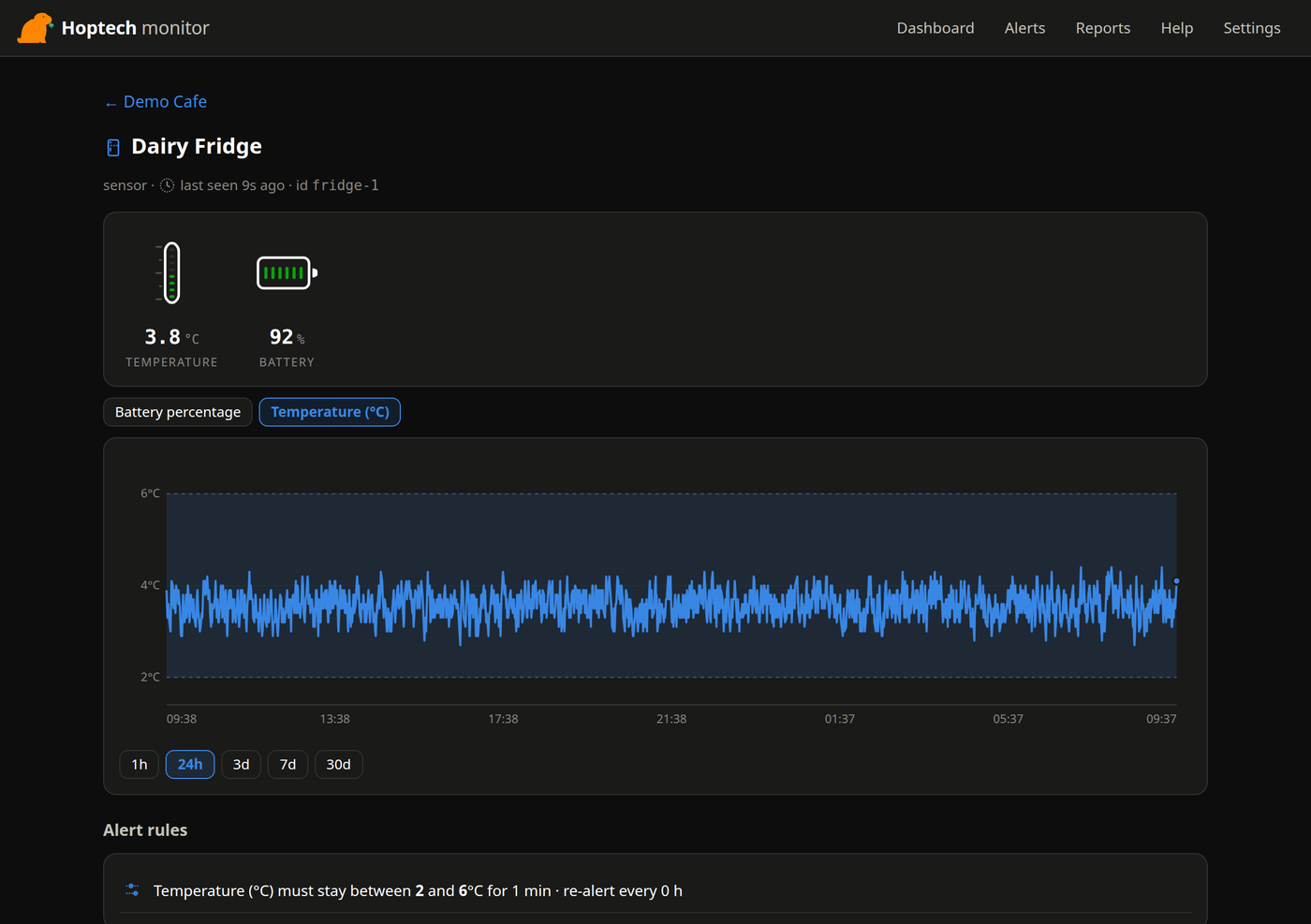
1 hour to 30 days on the same chart, with the allowed range shaded behind it.
The outage case
Power cuts are the event that exposes a monitoring system, because most of them stop recording at exactly the moment the record becomes valuable.
Hoptech splits the job so that does not happen. The sensors are battery powered and keep reading regardless. The gateway holds readings locally and back-fills them when the connection returns, so an internet outage costs you nothing at all. If mains power goes too, the gateway going quiet raises its own alert inside the window you set, which is how you find out that the site is dark rather than that the sensors are fine.
The practical upshot: after an outage you can answer the question that actually gets asked, which is not "did the power go off" but "how warm did it get, and for how long".
Several sites, one view
Stores, a packhouse and a distribution site sit under one organisation with one login. Staff can be limited to the site they work at, so a site manager sees their own rooms and not head office's. Reports are produced per site, per month, and every month downloads as CSV if you would rather do your own analysis.
Questions
How many sensors does a cool store need?
More than one, always. A room is not a single temperature: the air by the door, the air at the back and the air near the ceiling can differ by several degrees on a busy day. Two sensors is the minimum for a small chiller, and a large store usually wants one per aisle or per zone, plus one near the door where the worst case lives.
Will Bluetooth reach through racking and stock?
Usually, but it is the thing to check rather than assume. Bluetooth Low Energy at 2.4 GHz passes through cardboard and plastic reasonably well and through dense frozen product and steel racking much less well. One gateway covers a small store comfortably; a large or heavily racked one may want a second. We size it on the layout rather than the floor area.
What about defrost cycles?
A defrost cycle will lift the air temperature briefly and look exactly like a fault if you alert on the instantaneous reading. Hold times handle it: set the rule to require the temperature to stay out of range for longer than a defrost lasts, and the cycle is ignored while a failure is not. The defrost still shows in the history, which is useful when you are arguing about whether one is running too long.
What happens in a power cut?
The sensors keep reading, because they run on their own batteries. The gateway keeps collecting and stores the readings locally, then back-fills them when power and internet return, so the record covers the outage instead of having a hole in it. If the gateway loses power too, its silence raises an alert of its own within the window you set.
Can I monitor humidity as well?
The platform handles humidity alongside temperature and treats it as its own metric with its own range and its own rules, so a humidity sensor appears on the same dashboard and in the same report. Talk to us about what your room needs before ordering.
Can a customer or an auditor be given access?
You can add people with their own logins and limit them to particular sites. For anyone who should not have a login at all, the monthly report is a page you can send, and every month downloads as CSV.
Send us a floor plan
Sensor placement is the part worth getting right, and it is quicker to look at a layout than to describe one. Email a plan or a few photos and we will come back with a sensor count and a quote.